In Paris, design just feels different. There’s a freedom…an unspoken permission to mix periods and palettes, to follow feelings over formulas.
In this Haussmannian apartment (named for the grand 19th-century renovations led by Baron Georges- Eugène Haussmann), that sense of creative liberation pulses through every room. It’s a space that honors its architectural bones while embracing a bold, modern spirit. The result is as if old-world elegance met a fearless curator with an eye for soul—and they fell madly in love.
The apartment was reimagined by Nazak Savitt, founder of her eponymous firm, Nazak Savitt Studio, in collaboration with Paris-based architect Philippe Tasso of Nooor Architecture. Born in Iran and raised in Paris, Savitt trained at Yves Saint Laurent and worked under iconic designer Andrée Putman before founding her own design practice. With studios in both New York and Paris, she brings a distinct point of view to each project: global, collaborative, and emotionally resonant. For this apartment, originally a four-bedroom, the layout was reimagined with a more modern rhythm—converting a former kitchen into a serene primary suite and relocating the kitchen to a sunlit front room.
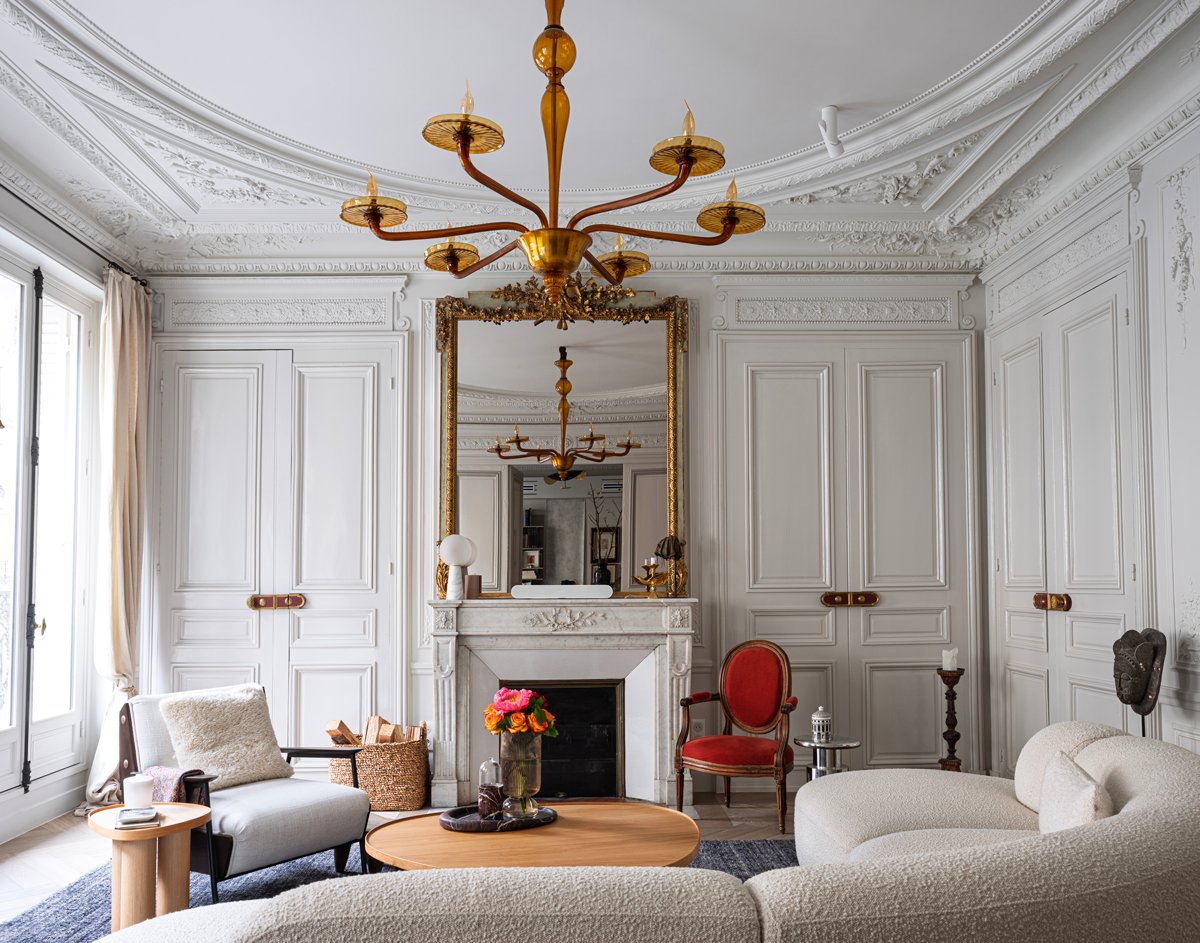
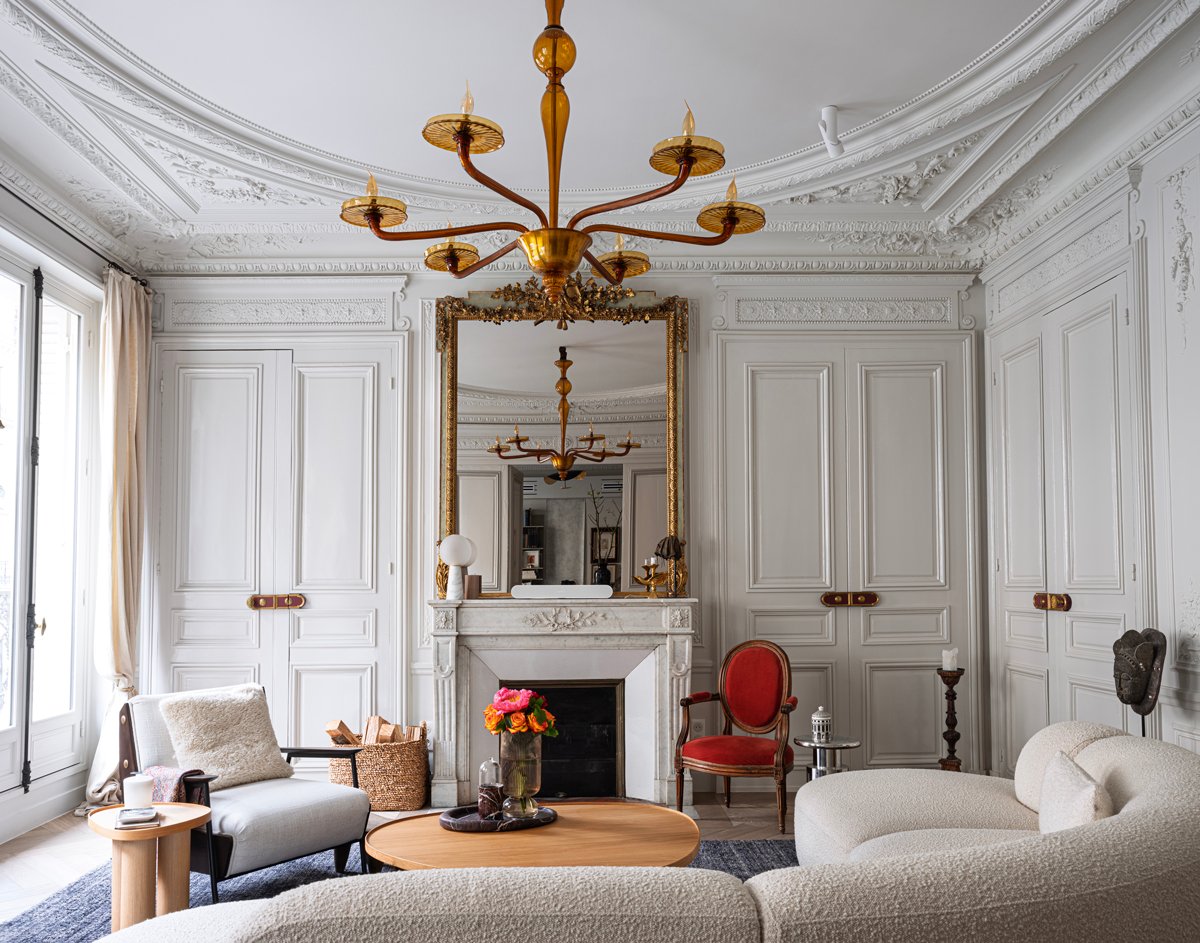
Located in the heart of the Jardin du Luxembourg on the coveted second floor—known in Paris as the premier étage or bel étage—this apartment embodies the quintessential Haussmann layout, reimagined for contemporary life. In 19th-century buildings like this one, the second floor was considered the most desirable: elevated yet accessible, with the highest ceilings and finest architectural details. The preserved ornate crown moldings and soaring ceilings nod to the home’s historic roots, but each room tells a distinctly modern story. The designer’s approach? Playfulness with purpose. “It’s not about matching,” she explains. “It’s about feeling. The pieces should speak to one another, not shout over each other.” Nothing is overly precious yet everything is intentional.
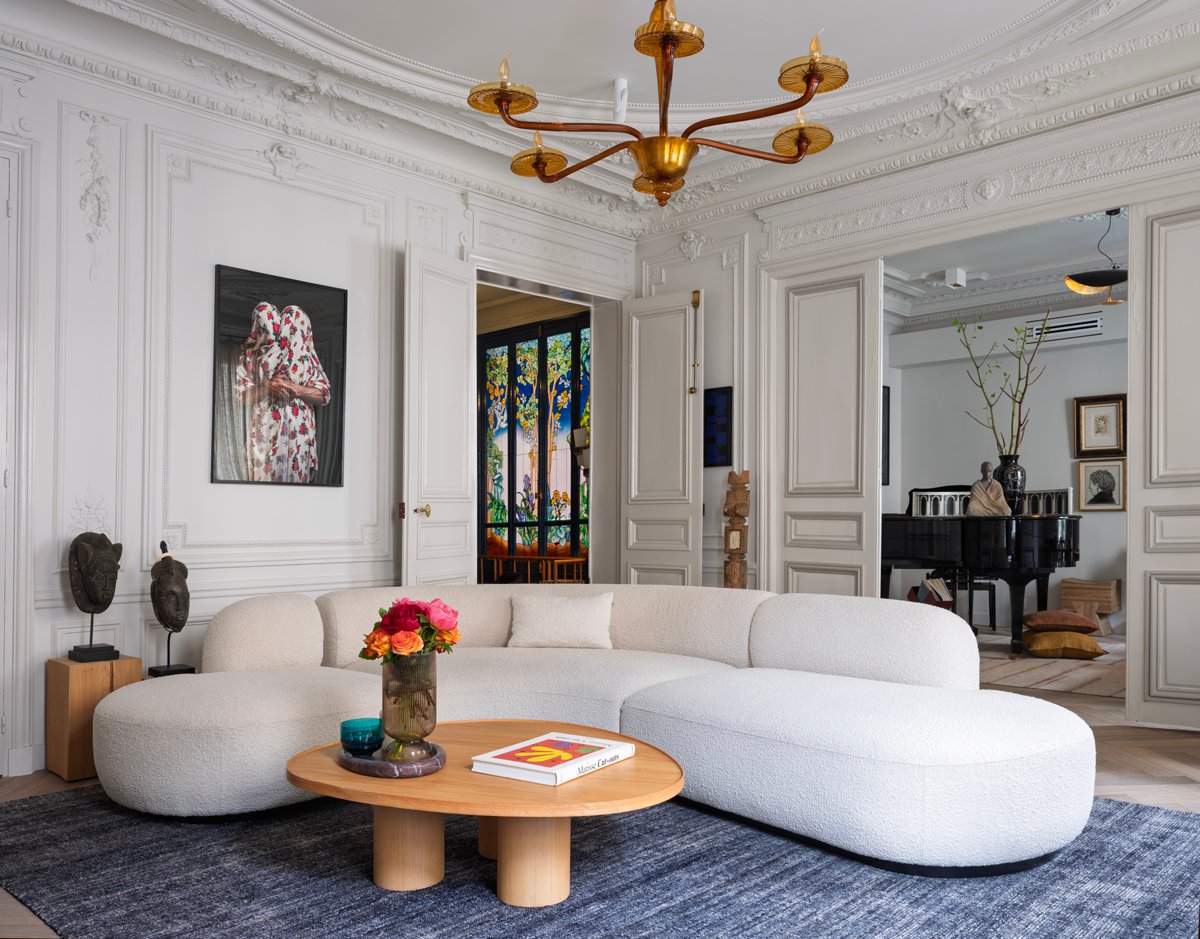
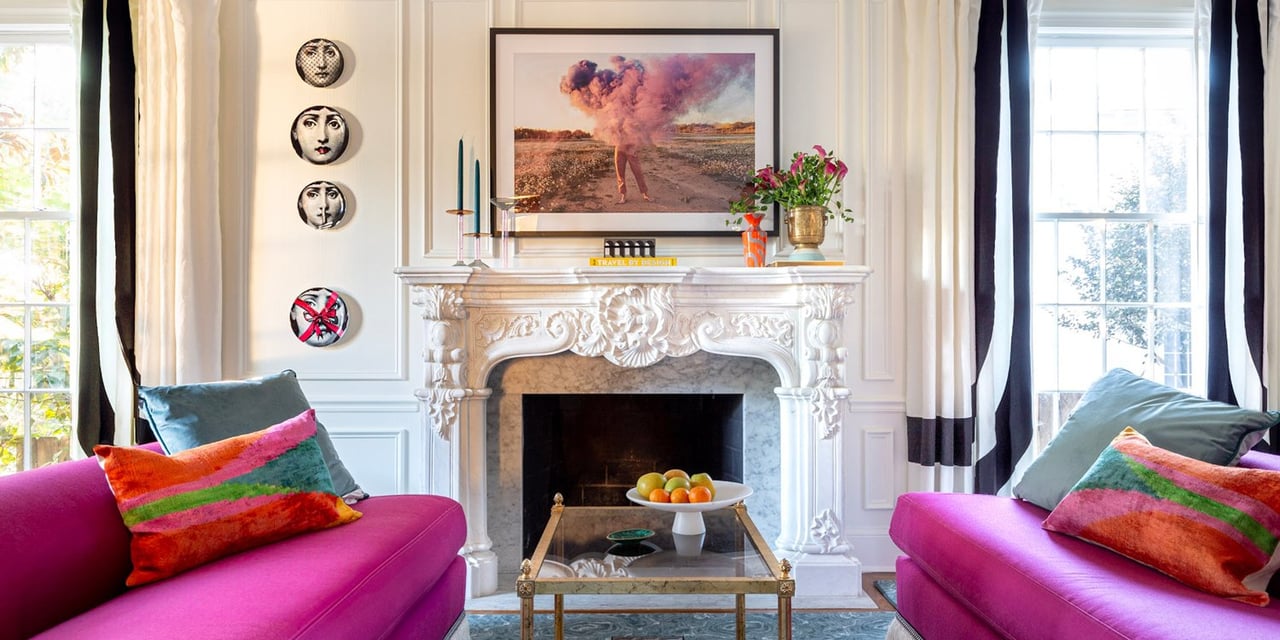
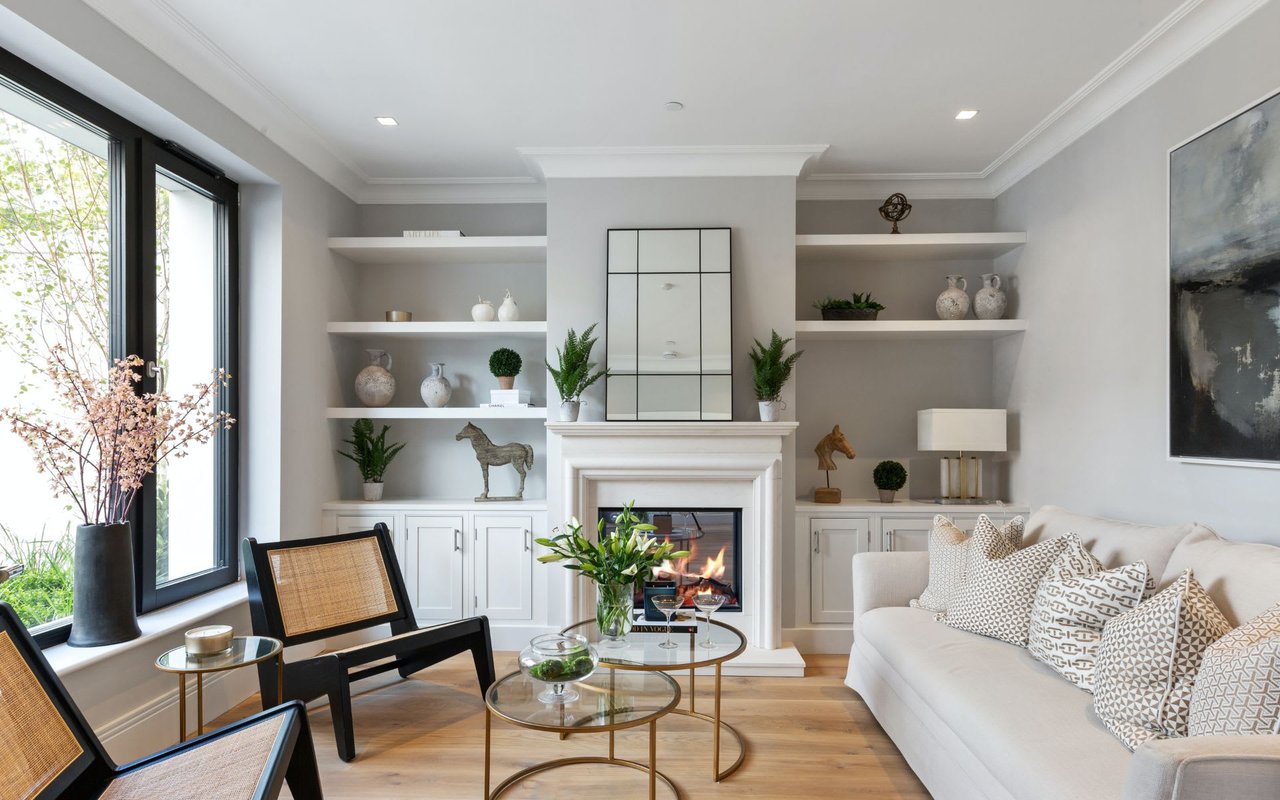
In the main living room, a cream bouclé curved sofa and sculptural wooden coffee table offer modern softness against the linear drama of antique moldings. A Louis XIV red velvet side chair leans regally nearby, while two African Baule masks bring global gravitas. Floating above, a golden-hued Murano glass chandelier—an original 1930 design by Napoleone Martinuzzi, who worked for Venini and is known for his coupelles à rebord and cache bélière forms—adds a sculptural glow. Sourced from Global Interior Design, it hangs in quiet harmony with a gilded mirror above the fireplace that cleverly conceals a television. It’s these moments of duality—past and present, functional and fantastical—that define the space.
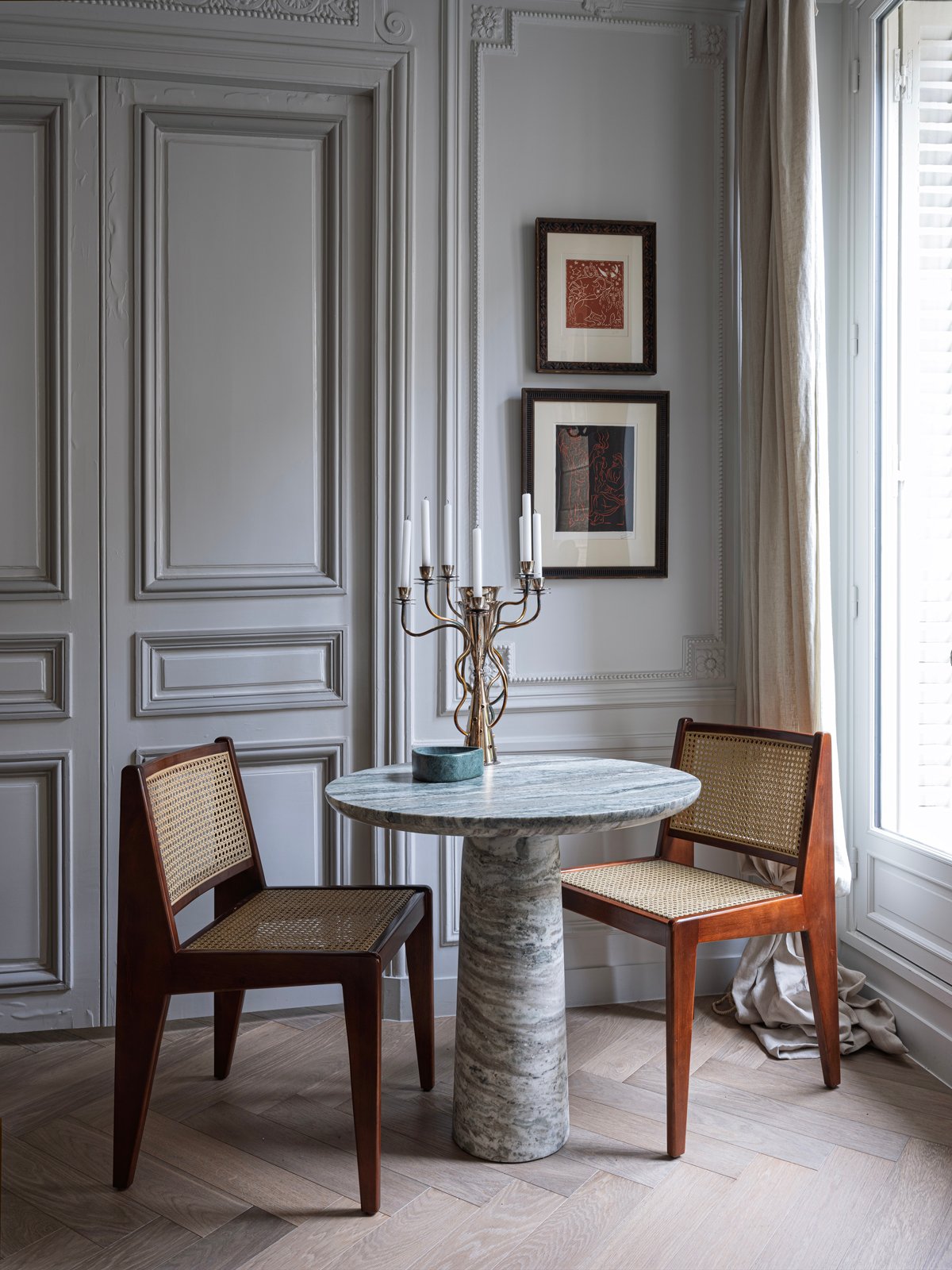
The art throughout is striking but never overpowering. A photograph from Iranian artist Ali Sabouki’s Embracing series commands attention with its cloaked figures and silent intimacy. Behind the piano, two black works by Azita Panahpour, whose sculptural art was recently acquired by the Islamic Department of the Met, create a quiet, commanding backdrop. In a home with such grand gestures, small framed artwork and understated compositions invite a slower gaze. Near the marble-topped table in the living room, two woodblock prints by André Derain hang in subtle conversation. Beneath the piano, a pair of custom Moroccan pillows and a Tibetan singing bowl suggest a space for stillness and breath.
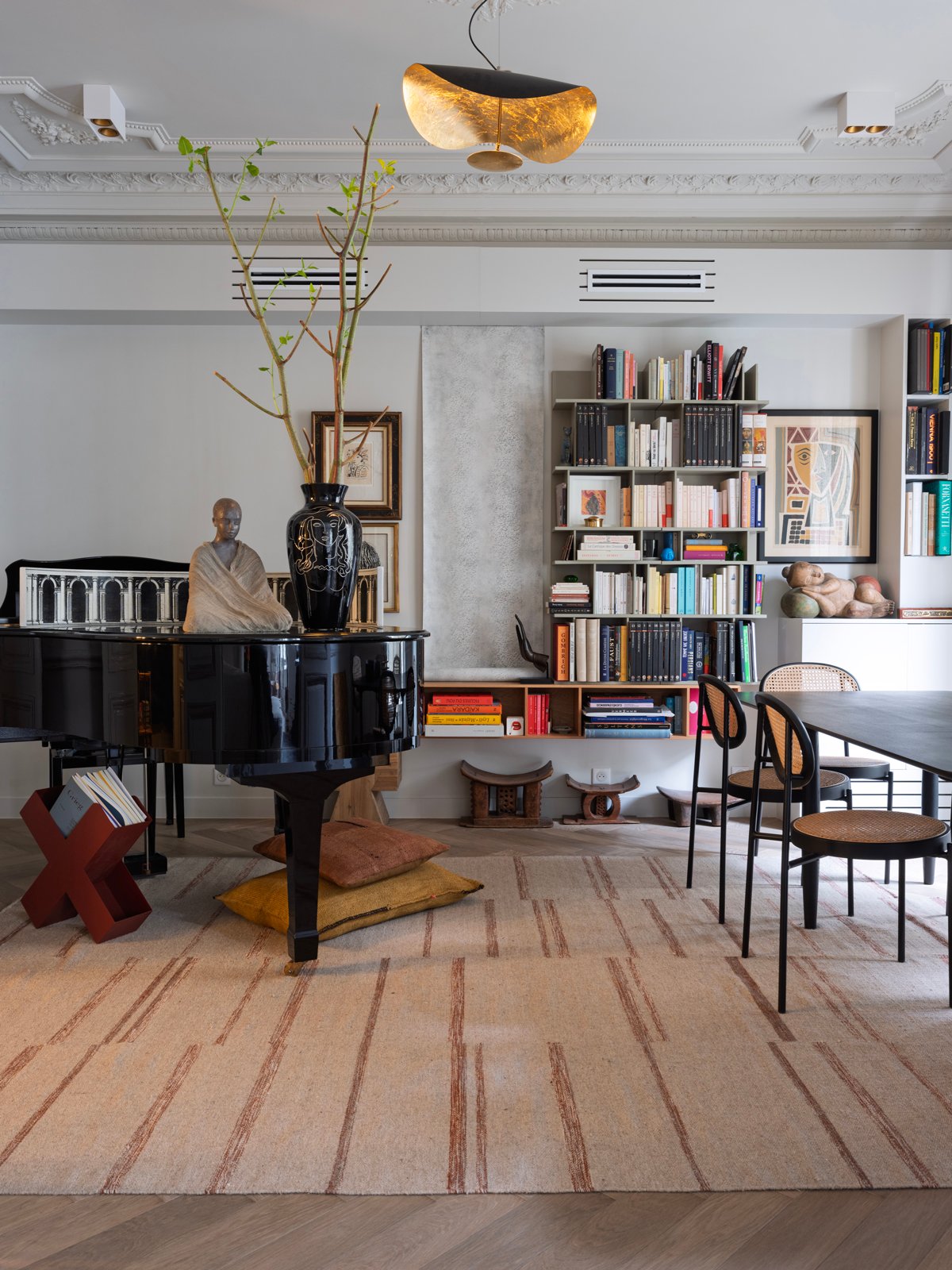
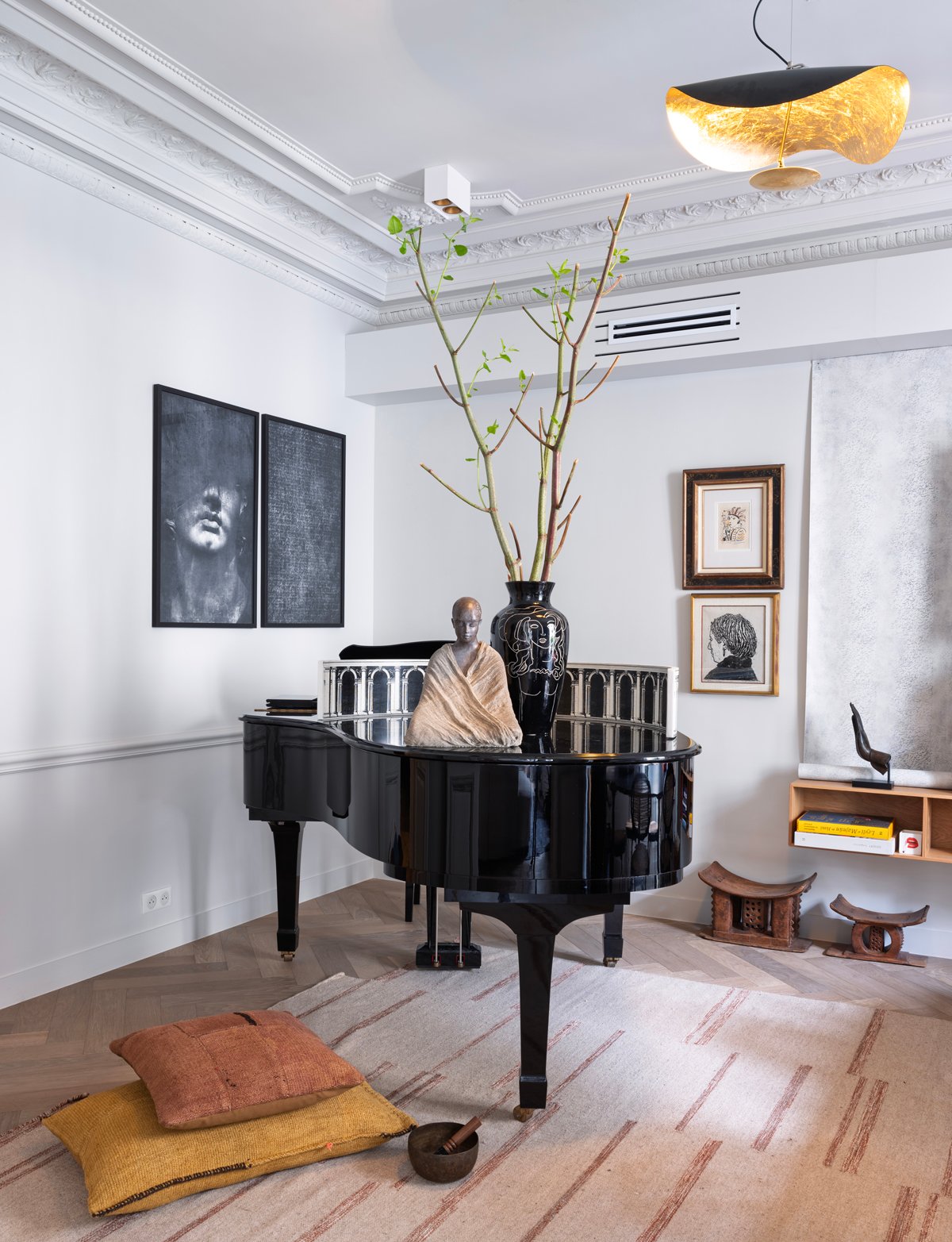
Through wide herringbone floors and double doors, the living room spills into the dining room, where custom bookshelves and a black lacquered baby grand piano turn the space into a salon for both meals and music. It’s here that the designer’s long-held wish to own a piano takes center stage. Topped with oversized stems and artwork, the piano feels like sculpture. Among the art objects are a Fornasetti piece and a sculpture from Annie Samuelson’s Bienveillant series, discovered at Galerie Bettina. Overhead, the dining room glows beneath a Lederam fixture by Catellani & Smith.
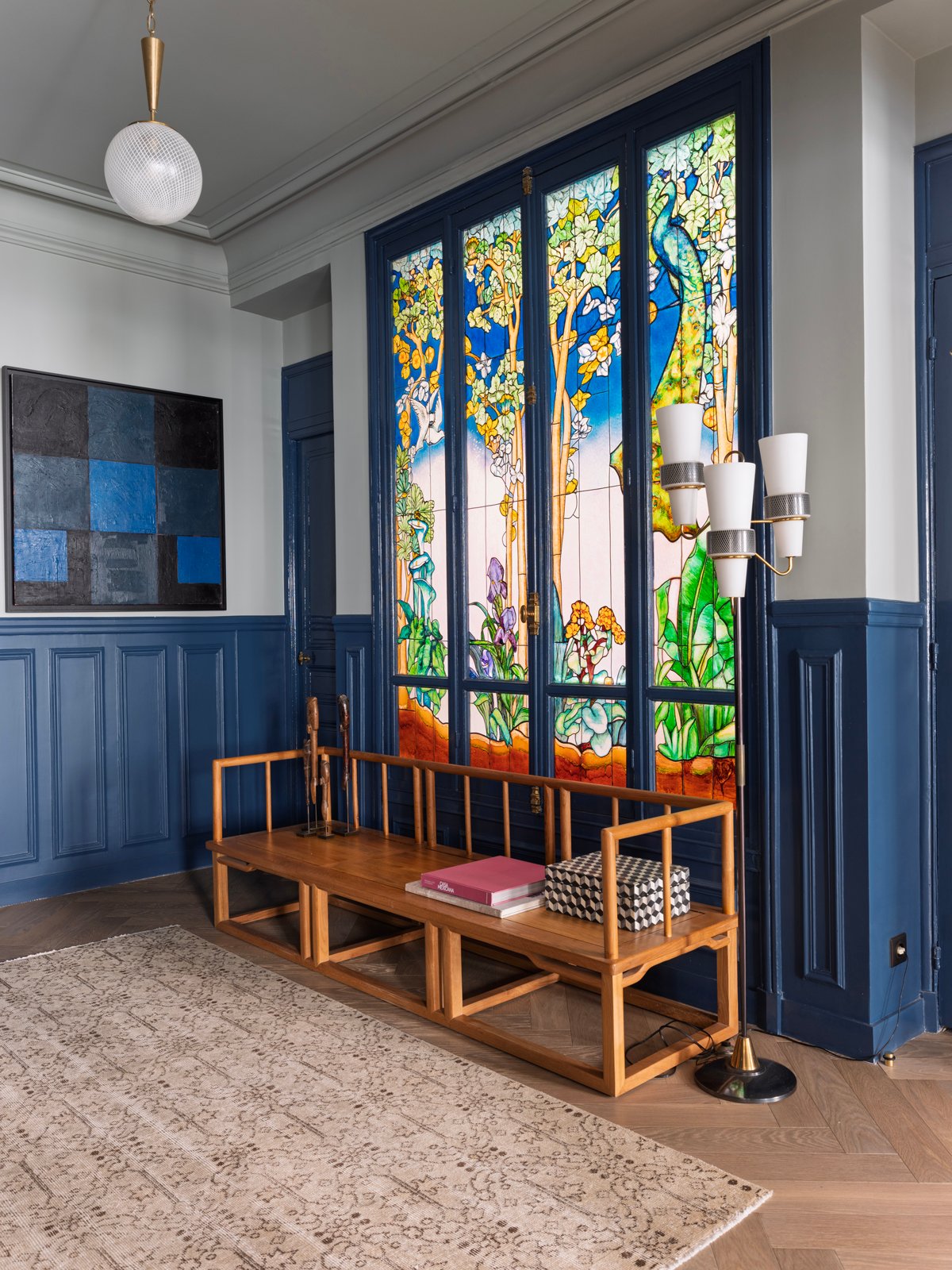
The adjacent foyer continues the artful storytelling. A stained glass window depicting trees and florals, installed by the previous owner, filters soft light into the hallway. Though not initially Savitt’s style, instead of replacing it, the designer embraced it, pulling rich cobalt blue from the glass to paint the trim, doors, and lower walls. It’s an unexpected gesture that both grounds and elevates the space. Overhead, a 1930s Carlo Scarpa for Venini fixture crafted using the reticello technique radiates softly. A nearby floor lamp, an Italian vintage piece from the 1950s with three conical glass shades, adds warmth and whimsy.
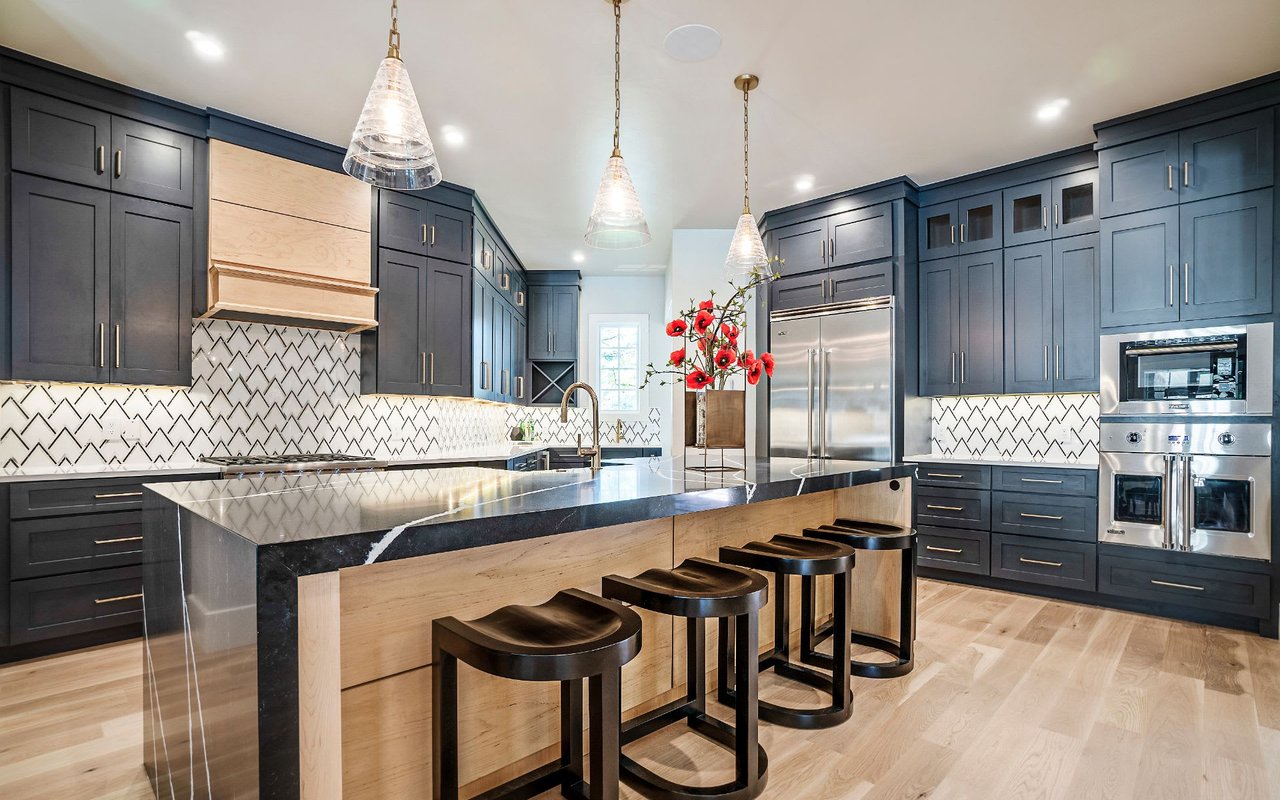
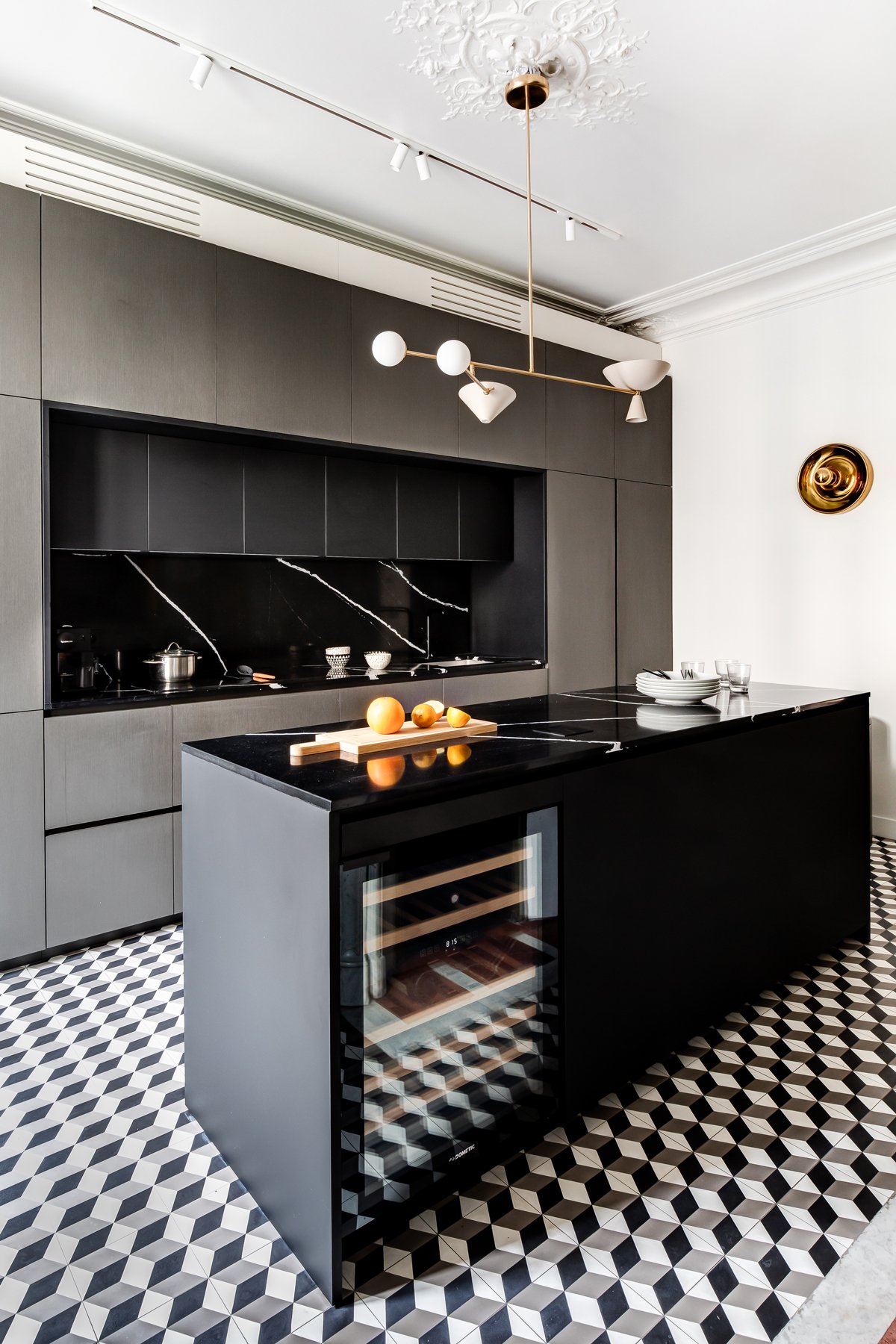
In contrast to the ornate heritage features elsewhere, the kitchen is unapologetically modern. Sleek Italian cabinetry in a matte anthracite grey finish and a geometric tiled floor set a contemporary tone, while vintage lighting including a brass sconce and sculptural chandelier, adds warmth. An original marble fireplace remains intact, proving that elegance and efficiency aren’t mutually exclusive. Along the wall, a collection of cutting boards dangle from leather straps—functional, beautiful, and unmistakably personal. The central island becomes a convivial gathering spot, where friends linger over conversation or an aperitif.
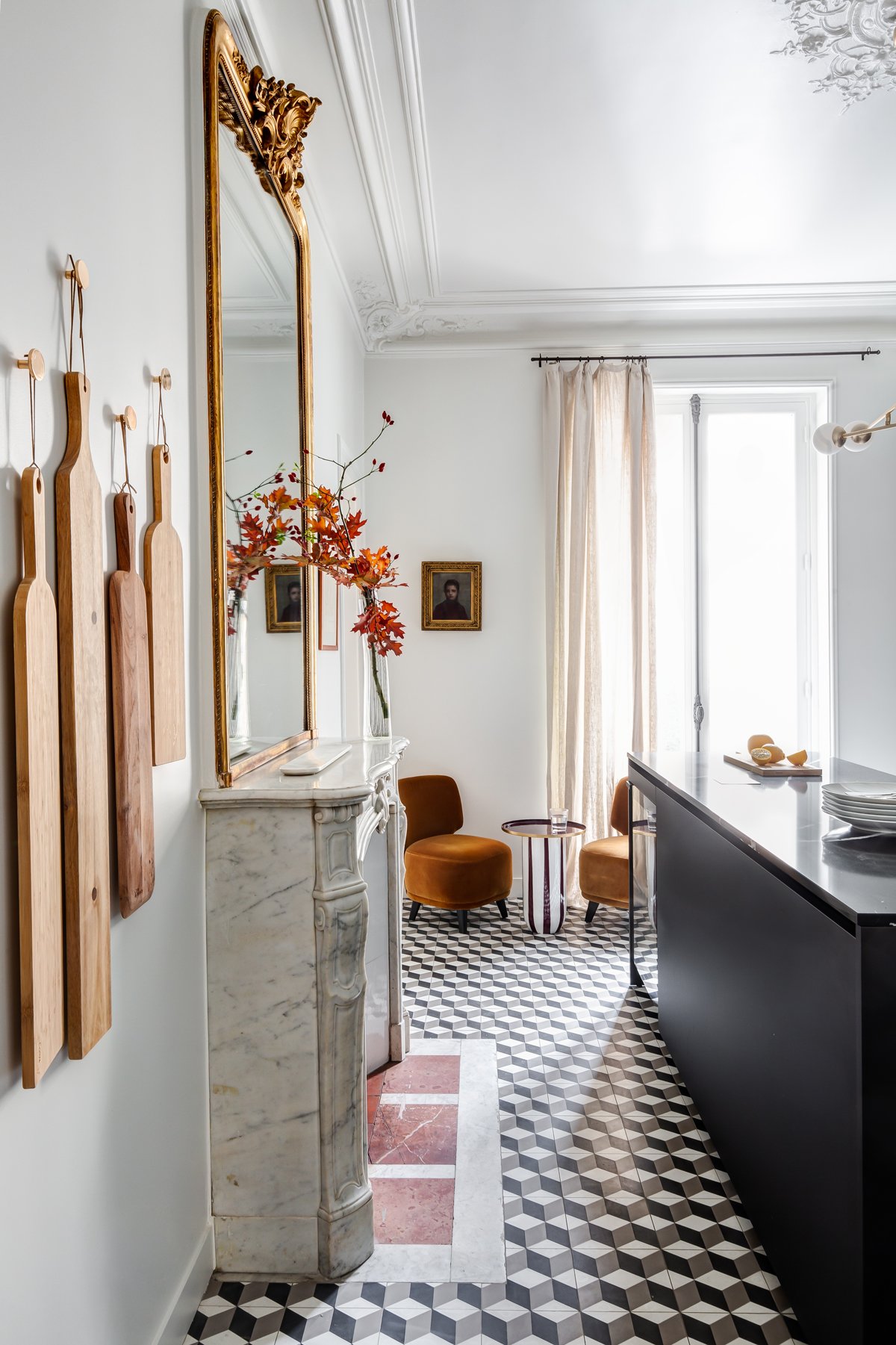
Near the kitchen windows, a vignette perfectly illustrates Savitt’s playful approach to scale and detail: two rust-colored velvet chairs, a vintage marble-topped table, and a diminutive oil portrait in an ornate gold frame hover in a moment that’s both surprising and serene. Here in the kitchen, there is also art by French artist Annabelle d’hart. The play in proportion draws the eye and softens modern edges. Belgian linen draperies return here, echoing those seen in the living room.
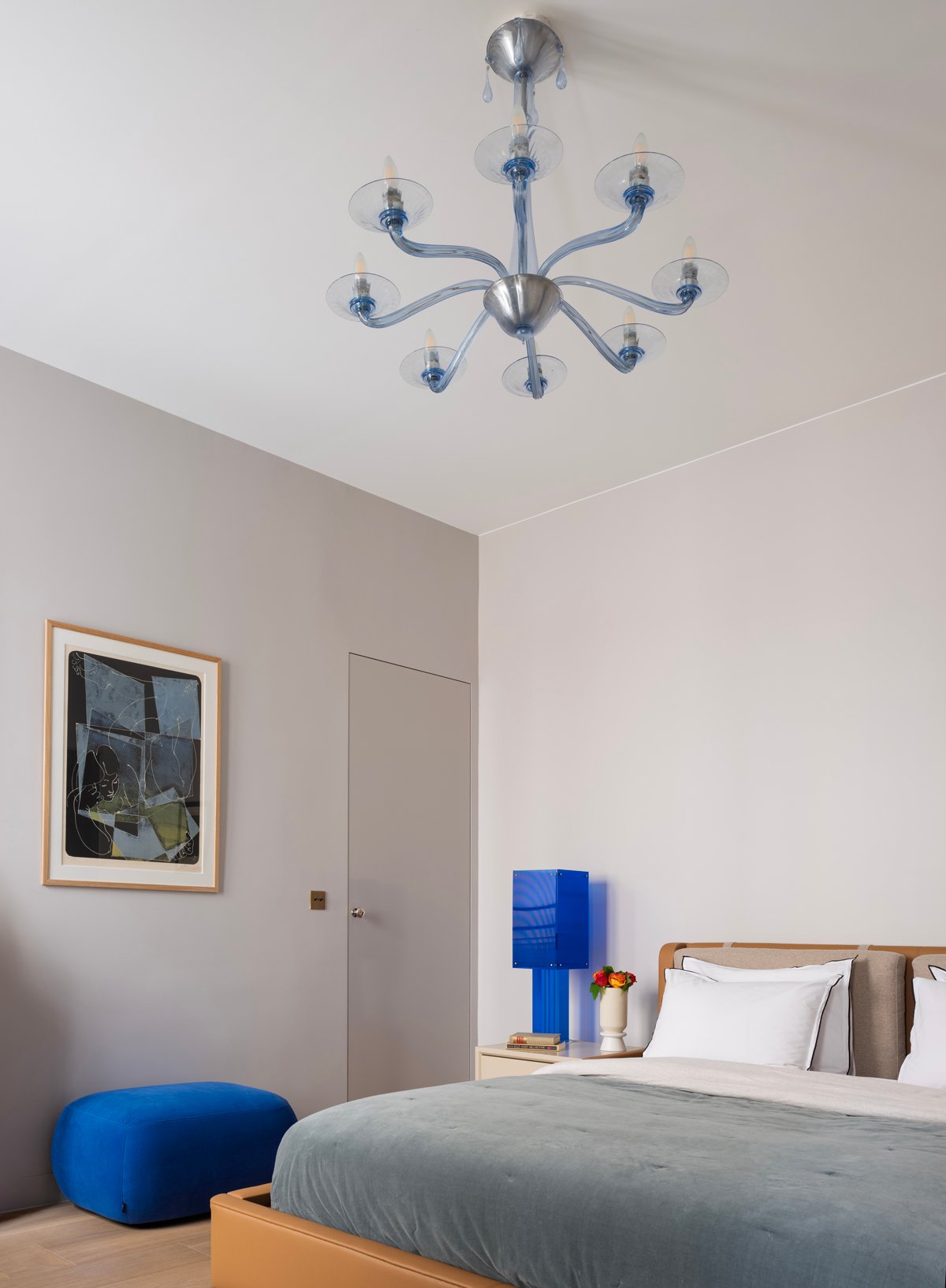
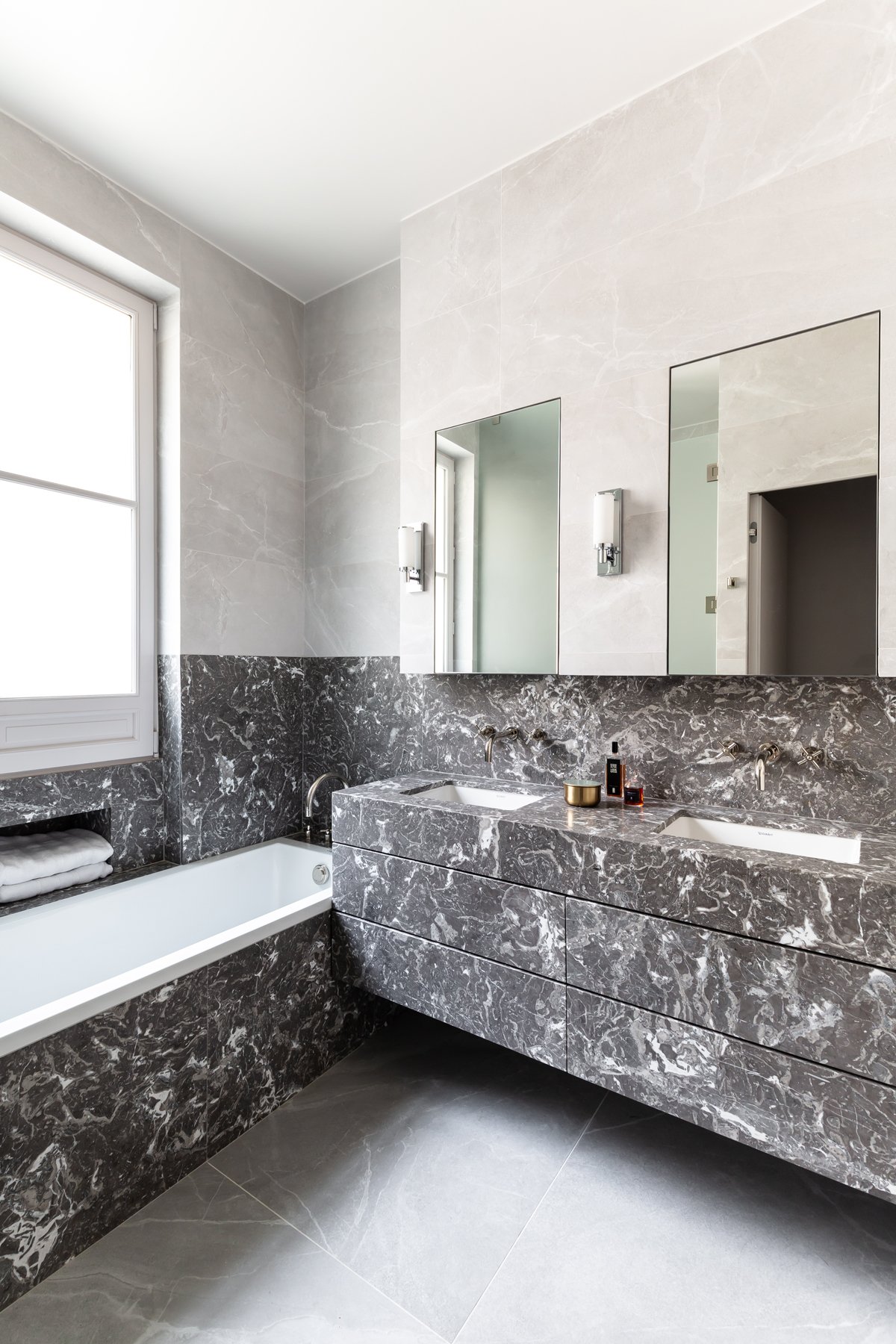
The primary bedroom is a study in serenity—with surprises. Pops of cobalt blue appear in a Murano chandelier, a lucite bedside lamp, and the ottoman, offering bursts of energy within a muted palette. The primary bathroom perhaps best captures the apartment’s ethos. Richly appointed, it features rare Gris de Sainte Anne marble from Belgium on the vanity and tub surround. Italian porcelain tiles climb the walls. Milk glass fixtures and polished chrome hardware add a touch of vintage hotel glamour.
This apartment isn’t designed to impress; it’s designed to express. To celebrate contrast. To invite curiosity. In a world where interior trends can feel prescriptive, this project is a reminder that the most memorable spaces are the ones that follow instinct over instruction. As the designer herself puts it, “Every object should speak—but not in unison. That’s where the harmony comes in.”
This Parisian apartment is a space that refuses to be categorized, where a Louis XIV chair converses easily with African sculpture, and Murano glass catches light beside contemporary art. In one corner, a silver-plated, seven-armed candelabrum by Czech designer Bořek Šípek for Driade twists upward like a lyrical punctuation mark. The magic lies in Savitt’s ability to layer history and modernity so seamlessly that the result feels inevitable, from the heart, as if the apartment has always been this way. And perhaps that’s the most effortlessly chic approach of all.
TEXT BY JASMINE BIBLE + PHOTOGRAPHY BY ALI SABOUKI AND SOPHIE LLOYD
— We shared this House Tour: Playful Precision story with you in the Winter 2025 issue of NEST Magazine.